

Visual impairment does not automatically prevent a person from living well in assisted living. With thoughtful environmental changes, accessible communication, and individualized routines, many seniors with low vision or blindness can move safely, make choices, and remain involved in daily life.
What adaptations help seniors with visual impairments most?
The most useful adaptations reduce glare, improve contrast, make important objects easier to locate, and keep walkways predictable. Support should be based on the resident’s actual vision, habits, medical history, and comfort level rather than on a diagnosis alone.
Common adaptations include:
- Brighter, evenly distributed lighting without harsh glare
- High-contrast markings on steps, doorframes, light switches, and grab bars
- Clear pathways free of loose rugs, cords, furniture, and unexpected obstacles
- Consistent placement of personal belongings
- Large-print, tactile, or audio versions of schedules and instructions
- Verbal descriptions of surroundings, meals, activities, and changes in the environment
- Handrails and other supports that are easy to see and reach
A person with macular degeneration may need help seeing fine detail, while someone with peripheral vision loss may struggle to notice objects at the side. Adaptations should reflect these differences.
How should lighting be adjusted?
Lighting should be bright enough for reading and walking but controlled enough to prevent glare. Glare from polished floors, uncovered windows, mirrors, or bright overhead fixtures can make vision less usable even in a well-lit room.
Useful lighting practices include:
- Use several moderate light sources instead of one extremely bright fixture.
- Add task lighting near a reading chair, bathroom mirror, closet, or dining area.
- Place lamps where cords will not cross walking paths.
- Reduce sharp transitions between dark and bright areas.
- Use window coverings to control intense sunlight, especially during morning or late-day hours.
- Keep stairways, entrances, hallways, and bathrooms consistently lit.
Seasonal changes can affect comfort and safety. In Coatesville, winter evenings may become dark early, while snow or wet pavement can create outdoor glare. A resident may need different lighting support during evening transportation, outdoor activities, or walks near entrances.
Why are contrast and color important?
Contrast helps a person distinguish one surface or object from another. A white plate on a light-colored table may be difficult to see, while a plate with a darker color creates a clearer boundary. The same principle can make bathroom fixtures, furniture edges, and doorways easier to identify.
Helpful examples include:
- Dark handrails against light walls
- Light-colored light switches on darker walls
- A contrasting toilet seat and grab bars
- Bright tape along the edge of a step
- Dark placemats beneath light dishes
- A contrasting blanket or pillow to make the bed easier to locate
Color preferences should be individualized. Some people see yellow or blue more clearly than other colors, while others depend more on brightness contrast than hue. Patterns can also be confusing, so solid colors are often easier to interpret than busy designs.
How can falls and navigation problems be reduced?
A predictable environment is often safer than an environment that is merely attractive. Furniture should remain in consistent locations, and staff or family members should explain changes before moving items.
Important safety practices include:
- Keep hallways and doorways clear.
- Remove unsecured rugs and mats.
- Secure or cover electrical cords.
- Close cabinet and closet doors.
- Mark the first and last steps of stairways with high-contrast strips.
- Keep frequently used items within an easy and consistent reach.
- Avoid leaving carts, chairs, cleaning supplies, or personal belongings in walking paths.
- Provide verbal notice when floors are wet or furniture has been moved.
Residents should also be shown how to find key areas, such as the dining room, bathroom, activity spaces, and exits. Repeated routes can become easier to manage when landmarks remain consistent. A staff member may describe a hallway by its turns, flooring changes, sounds, or nearby doorways rather than relying only on visual signs.
What communication methods are most helpful?
People with visual impairments need information in formats they can use independently. Speaking louder is usually not helpful unless hearing loss is also present. Clear, direct language is more useful than pointing or saying, “It is over there.”
Helpful communication habits include:
- Say the resident’s name before speaking.
- Identify yourself when entering the room.
- Explain who else is present.
- Describe where food, clothing, furniture, or personal items are located.
- Read written notices aloud when requested.
- Offer large-print, audio, electronic, or tactile information when appropriate.
- Tell the resident before leaving the room.
- Ask before providing physical assistance.
When guiding someone, the person should be allowed to hold the guide’s arm rather than being pulled or pushed. Directions such as “two steps ahead” or “the chair is on your left” are more useful than vague gestures.
How can bathrooms and personal-care areas be made safer?
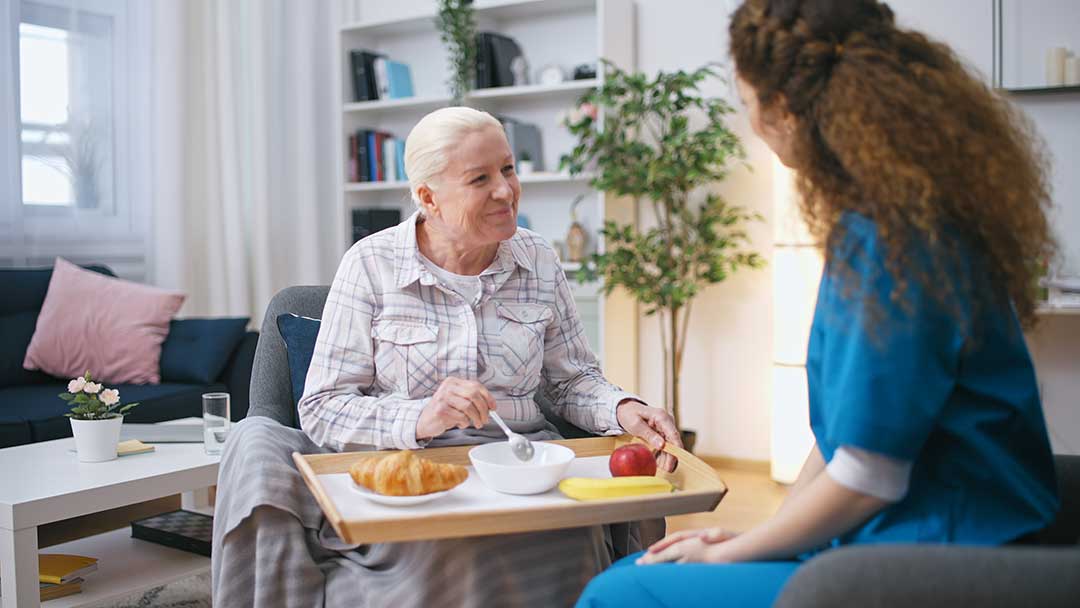
Bathrooms require particular attention because they combine water, hard surfaces, limited space, and frequent transfers. Adaptations should support both visibility and physical stability.
Possible changes include:
- Non-glare, slip-resistant flooring
- Strong contrast between the floor, walls, toilet, and sink
- Clearly identifiable hot and cold controls
- Grab bars that are easy to see and securely mounted
- Even lighting around the sink and shower
- A shower seat when standing is difficult
- Tactile labels for frequently used controls
- Consistent placement of soap, towels, toiletries, and clothing
Water temperature deserves special attention. A resident with limited vision may have difficulty judging whether water is too hot, particularly if sensation is also reduced by diabetes or another condition.
What role do staff routines and resident preferences play?
Adaptations work best when they are consistent across shifts. Staff should know how a resident prefers to receive directions, whether the person uses a cane or other mobility aid, and which activities are completed independently.
A useful support plan may record:
- The resident’s preferred method of guidance
- Areas where assistance is needed
- Lighting preferences
- How medications, clothing, and personal items are organized
- Any history of falls or near-falls
- Whether the resident needs help reading menus, activity schedules, or labels
- What changes in vision should be reported to the resident’s healthcare team
Support should not become unnecessary dependence. Staff can offer an arm, explain a route, or read a label while still allowing the resident to make decisions and complete familiar tasks.
What technology and low-cost tools can help?
Simple tools can improve independence without changing the entire living space. Examples include talking clocks, magnifiers, large-print calendars, tactile labels, high-contrast tape, motion-sensor night-lights, and phones with accessible settings.
Audio instructions may help with schedules or reminders, while tactile markers can identify similar containers or appliance controls. Any device should be tested with the resident. A tool that seems helpful in theory may be difficult to operate because of limited dexterity, hearing loss, memory changes, or unfamiliarity with technology.
Family members and staff should also review privacy and consent before using cameras, monitoring systems, or digital devices.
What should families ask before a move or care-plan review?
Families can ask how the living environment handles visual accessibility and how individualized support is documented. Useful questions include:
- How are rooms arranged to reduce trip hazards?
- Can schedules, menus, and notices be provided in accessible formats?
- How are residents guided during emergencies or evacuations?
- Are lighting and contrast reviewed after a fall or near-fall?
- How are changes in furniture or room assignments communicated?
- Can the resident practice routes to important areas?
- How are vision changes reported and incorporated into care planning?
Emergency planning deserves special attention. Smoke, alarms, unfamiliar routes, low lighting, and crowd movement may make evacuation difficult. A resident with visual impairment should have a clear, practiced plan that accounts for mobility, hearing, and the possibility of power loss.
The goal is not to make every room identical or to remove all risk from daily life. The goal is to create an environment that is understandable, predictable, and respectful of the resident’s abilities while providing assistance where it is genuinely needed.
